News & Insights

European and UK Banks: Capital Discipline, Recovery, and the Case for Re-Rating

Executive Overview

The European and UK banks have emerged from over a decade of post-crisis restructuring with significantly stronger balance sheets and a newfound commitment to capital discipline. After a period of structural underperformance relative to their U.S. counterparts, these banks are currently exhibiting robust capital returns, lower risk profiles, and dramatically improved profitability.

A deep analysis reveals that valuation discounts persist in Europe despite a fundamental structural transformation across capital efficiency, credit quality, and payout policy. This misalignment between fundamentals and valuation may present a compelling opportunity for investors seeking durable yield and potential for significant capital appreciation via a multi-year re-rating.

The Path to Resilience: A Decade of Divergent Restructuring

Following the Global Financial Crisis (GFC), the global banking industry was forced into a period of deleveraging and recapitalization, focusing on cleaning up balance sheets and meeting stringent Basel III standards from 2008 through 2019. This process set the foundation for what appears to be a more sustainable and capital-efficient banking model.

U.S. Banks: U.S. institutions recapitalized quickly, regaining investor confidence by 2012. This allowed them to begin meaningful share repurchases by 2014, contributing to superior stock performance over the following decade.

European Banks: European peers experienced a more prolonged and inconsistent capital repair process. Their performance was hampered by fragmented regulatory supervision, extended consumer deleveraging, and a prolonged environment of negative interest rates (2016-2022) that depressed Net Interest Income (NII).

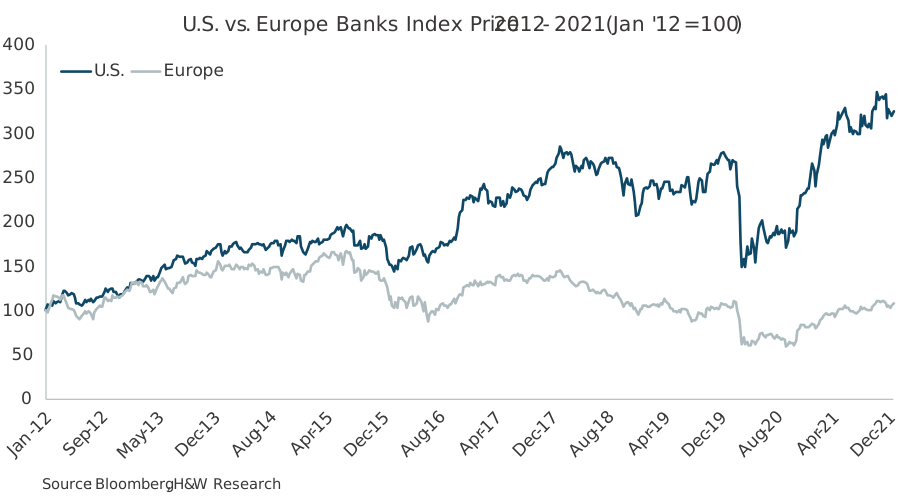
These factors masked the underlying structural improvements in efficiency that were being achieved by European banks and resulted in dramatic underperformance versus U.S. banks. Between 2012 and 2021, U.S. bank indices outperformed Europe by more than 100 percentage points.
The Case for Re-Rating: Structural Transformation in Europe

The past decade of restructuring has created a structurally resilient and more profitable banking sector in Europe, setting the stage for a valuation catch-up.

Robust Capital Strength and Shareholder Alignment 

Capital discipline is the defining feature of the current era. European banks have significantly fortified their reserves, with capital ratios dramatically increasing since the GFC. They have shed less productive assets and focused on markets and lines of business where they have competitive advantages and the potential to generate above cost of capital returns. Today, tangible common equity ratios have nearly doubled since 2007, with major European banks maintaining CET1 ratios above 13%.
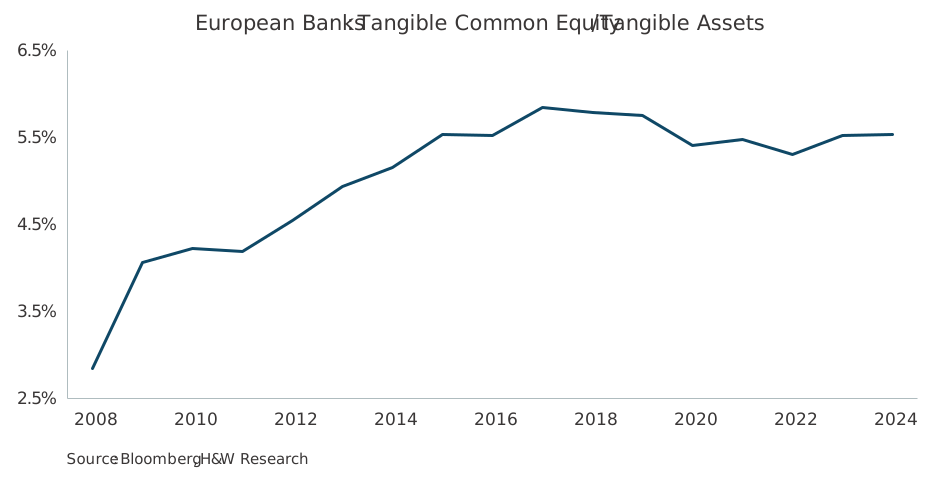
This capital strength and improved profitability may translate to increased shareholder returns.

Payout ratios which were well below U.S. peers during the prior decade are now similar to the US, producing strong capital return, and allowing management teams to potentially further improve shareholder value by retiring undervalued shares.

Even after strong price appreciation there are several European banks with payout yields exceeding 10%.

Resurgent Profitability and Efficiency

The normalization of monetary policy has been the primary catalyst for the sharp rebound in European bank earnings. Once central banks, including the ECB, began rate hikes in 2022, European banks experienced a large improvement in Net Interest Income (NII). Expense growth has remained contained due to digitalization and cost discipline, leading to strong operating leverage.
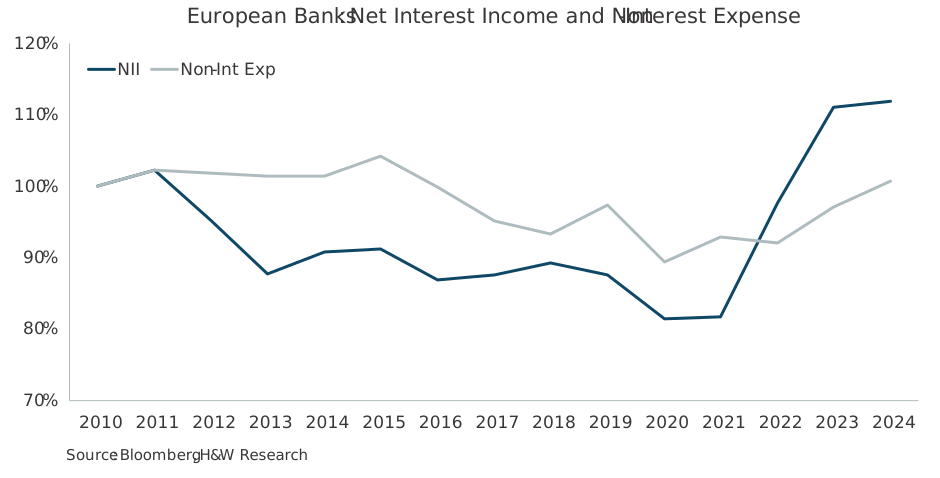
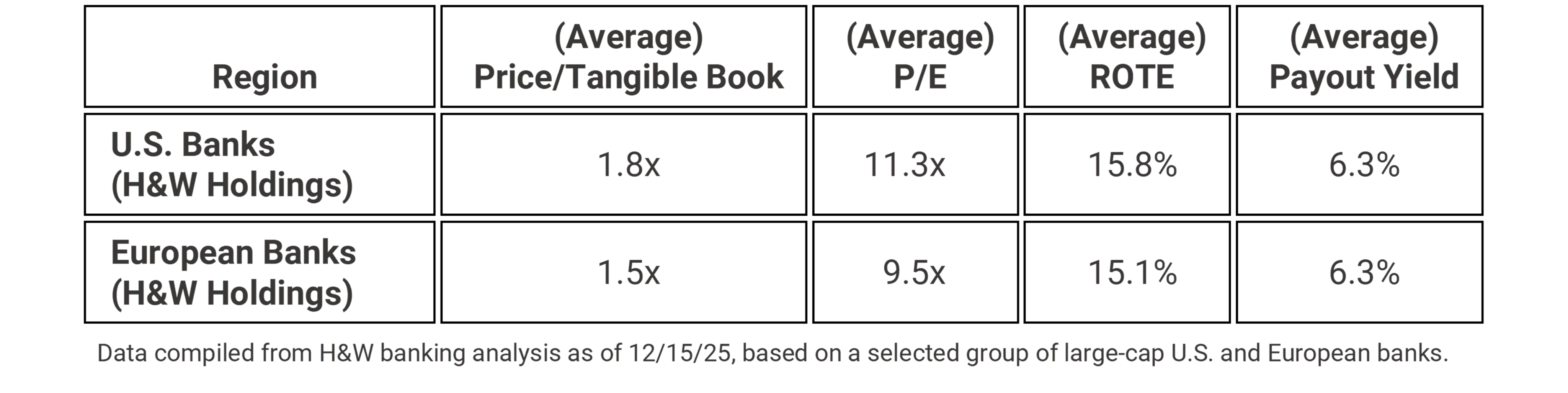
The resulting efficiency gains are driving Returns on Tangible Equity (ROTE) toward or above the cost of capital. Interestingly, our current U.S. and European bank holdings now exhibit similar ROTE levels, demonstrating the current strong recovery in European profitability.

Investment Implications: The Valuation Gap

Despite comparable or superior capital generation and profitability, European banks continue to trade at a discount to their U.S. peers. The table below highlights this misalignment:
Leading European franchises such as BNP Paribas, Lloyds and ING are identified as being potentially well-positioned for a multi-year re-rating driven by disciplined capital allocation and sustained profitability.

Conclusion

The transition from a leverage-driven model to one centered on capital-efficient profitability marks a fundamental inflection point for the European and UK banking sectors.

These banks now offer a compelling combination of value, yield, and improving fundamentals. For investors seeking stable income streams paired with significant potential for capital appreciation, a focus on banks that combine robust capital ratios with high payout capacity and operational discipline may be warranted. Even after meaningful stock price appreciation over the past two years, the case for a structural re-rating of European banks remains strong.

______________________________________

All investments contain risk and may lose value. This material is for general information purposes and should not be used as the sole basis to make any investment decision. Views expressed are not intended to be relied upon as research regarding a particular industry, investment, or the markets in general, nor is it intended to predict performance of any investment or serve as a recommendation to buy or sell securities.

The portfolio manager’s views and opinions expressed are subject to change without notice and may differ from others in the firm, or the firm as a whole. The portfolio manager’s comments may include estimated and/or forecasted views, which are believed to be based on reasonable assumptions within the bounds of current and historical information. Due to various risks and uncertainties, actual events/results or performance may differ materially from those reflected or contemplated in such forward-looking statements. Nothing contained herein may be relied upon as a guarantee, promise, assurance or a representation as to the future. In the event of new information or changed circumstances, Hotchkis & Wiley (“H&W“) reserves the right to change its investment perspective and outlook and has no obligation to provide revised assessments and/or opinions. H&W is not responsible for any damages or losses arising from any use of this information. Information obtained from independent sources is considered reliable, but H&W cannot guarantee its accuracy or completeness.

The securities highlighted were selected based on non-performance based criteria, are for illustrative purposes only and should not be considered investment recommendations. The securities were selected from one or more of our strategies and represents only a small portion of the respective strategy’s holdings. The securities do not represent all the securities purchased, sold, or recommended for advisory clients, and may not be indicative of current or future investments. No assumptions should be made that the securities highlighted, or all investment decisions were, or will be profitable. There is no assurance that the securities discussed will remain in the portfolio or that securities sold have not been repurchased. H&W’s opinions regarding these securities are subject to change at any time, for any reason, without notice.

European Central Bank (ECB); Basel III standards are a global regulatory framework for banks, developed after the 2008 financial crisis, to strengthen capital requirements, improve risk management, and enhance liquidity to make the banking system more resilient to economic shocks; Tangible common equity measures a company's physical capital and assesses a financial institution's ability to handle losses; a Tangible asset has a finite monetary value and usually a physical form; Returns on tangible equity measures the efficiency with which a company operates and utilize its tangible assets to generate long-term profits; CET1 (Common Equity Tier 1) ratio is a critical measure of a bank's financial strength, showing its core capital (common stock, retained earnings) relative to its total risk-weighted assets; Net Interest Income (NII) refers to the difference between the interest revenue generated by a financial institution and the interest expense it incurs; Price/tangible book is a valuation ratio that measures a company's market value against its tangible assets; Payout yield shows the total percentage of the company's market value returned to shareholders through buybacks and dividends; and Price-to-earnings (P/E) compares a company's share price with its earnings per share.

Investing in foreign as well as emerging markets involves additional risk such as greater volatility, political, economic, and currency risks and differences in accounting methods. Investing in equity securities have greater risks and price volatility than U.S. Treasuries and bonds, where the price of these securities may decline due to various company, industry, and market factors. A value-oriented investment approach involves the risk that value stocks may remain undervalued or may not appreciate in value as anticipated. Value stocks can perform differently from the market as a whole or from other types of stocks and may be out of favor with investors and underperform growth stocks for varying periods of time.

Principal Risks Disclosure for the firm’s strategies are described in Part 2A of Form ADV of H&W.

©2026 Hotchkis & Wiley. All rights reserved. No portions may be published, reproduced, or transmitted in any form without the express written permission of H&W.

Past performance is not indicative of future performance.

HOTCHKIS & WILEY
Privacy Overview

This website uses cookies so that we can provide you with the best user experience possible. Cookie information is stored in your browser and performs functions such as recognising you when you return to our website and helping our team to understand which sections of the website you find most interesting and useful.