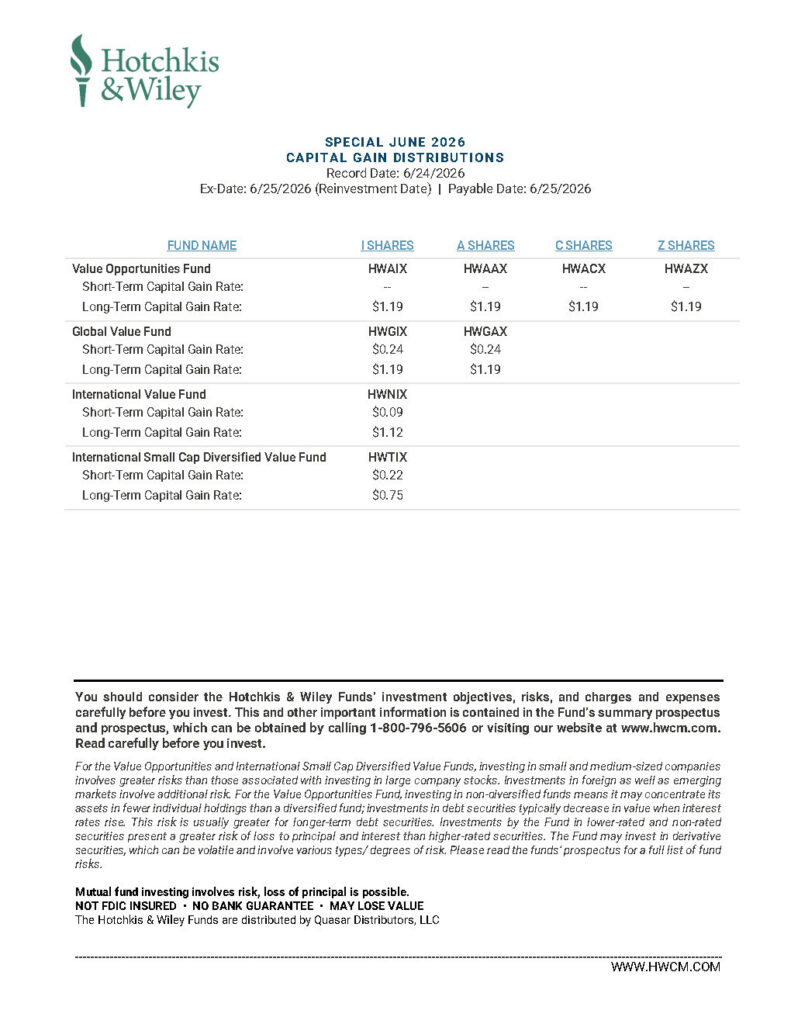
AI-driven disruption to application software is a topic that often comes up with our clients. Workday, one of our largest holdings, offers an example of how we think about the investment opportunity.

Like other investors, we’ve been impressed with the pace of innovation in AI. Today, the consensus view among investors is that AI could prove to be a significant headwind to incumbent software vendors, and the stocks of publicly traded software firms have sharply de-rated to reflect this increase in perceived risk.

While our research team thinks many software vendors could be negatively impacted by AI, we think the impact will vary widely depending on the company. We believe the software products that are most threatened by AI are those that are loosely integrated, lightweight point solutions. These software products are easy to install, easy to replace, and are often sold on short contracts or on a monthly subscription basis. At Hotchkis & Wiley, we have always assigned low-quality risk scores to these types of companies and we have avoided investing in them.

We believe Workday is very different. Workday is a deeply embedded, mission-critical system used by large, complex enterprises to run their core Human Resources (HR) and finance workflows. These are business processes that cannot fail and are closely scrutinized by regulators and auditors. Abandoning Workday would mean remapping years of configurations, absorbing significant switching cost, and accepting the risk of breaking core HR, payroll, or finance processes. Large enterprises are generally risk averse and they are extremely hesitant to replace core back-office systems of record like these.

The AI Bear Case Viewed Through Workday

The prevailing application software bear case has four main parts, but each looks very different for Workday than for a fragile, point solution software business.

First, as code gets cheaper to produce, investors worry about increased competition, both from new startups and from enterprises building their own software. We agree code is getting much cheaper to produce, but writing code has never been the hardest part of building a scaled enterprise software business. To quantify this, research and development (R&D) has been roughly half of Workday’s cumulative operating expenses to date. Only a portion of R&D employees at software firms are actually writing code, and only a portion of a developer’s time is spent coding. So while AI coding tools are driving R&D productivity gains, they do not dramatically change the overall cost structure of software startups or custom enterprise builds. Outside of R&D, sales and marketing capabilities remain as important as ever. Strong customer relationships, brand, and distribution partnerships take decades to build at scale. Meanwhile, cheaper code development helps Workday develop new functionality that it can cross-sell to its sticky installed base, which could be a meaningful tailwind to revenue growth.

Second, investors worry that AI agents will replace white-collar employment, reducing seat-based revenue streams. AI-driven layoffs have not yet appeared in broad employment data. However, if headcount pressure does eventually emerge, Workday has several important offsets. The company is currently shifting from mostly seat-based pricing toward a mix of consumption and seat-based pricing. Also, Workday’s multi-year contracts include inflation-based price escalators for most customers, so customers pay more each year even with flat headcount. Customers also often lose important discounts if they reduce the size of their contracts upon renewal.

Third, AI is changing the way users interact with software and could weaken moats built on user interface familiarity. This matters a lot for personal productivity and creative tools, but Workday’s moat has never been its user interface. In fact, one of the most common customer complaints is that Workday can often be cumbersome to use. For Workday, AI is an opportunity to improve this user interface weakness with new prompt-based navigation and agentic workflows that connect to common collaboration tools like Slack and Microsoft Teams. A more intuitive, AI-driven user interface could actually increase usage of Workday, a trend recently highlighted by application software peer Salesforce on its Q1 2026 earnings call.

Fourth, the most existential concern is that an agentic orchestration layer will be installed above HR and financials software, moving business logic into that layer and reducing incumbents to “dumb databases.” For lightweight solutions, we agree this is a genuine risk. For Workday, we are less concerned. Core HR, payroll, and the general ledger must be correct 100% of the time. Probabilistic AI models are not appropriate for this use case. For Workday, we think an agentic future is actually a positive, not a negative. Workday can monetize new agentic workflows through first-party agents and can monetize third-party agentic access to its systems of record via consumption pricing and API tiering. For enterprise-grade AI agents to produce real value, agent harnesses need access to accurate, up-to-date context, and much of this context for the back-office lives inside Workday. To date, evidence suggests that this context is not leaving Workday’s systems. Workday’s gross revenue retention remains at the high end for enterprise software at 97%, and our conversations with customers and consultants suggest Workday clients are firmly committed to Workday’s systems. Workday also continues to attract new customers. In Q1 of 2026, net new business drove 40% of Workday’s subscription revenue growth. Customers, including highly sophisticated AI labs like OpenAI, Anthropic, and Google, continue to sign new contracts with Workday, a signal Workday is still viewed as an important part of enterprise IT architectures.
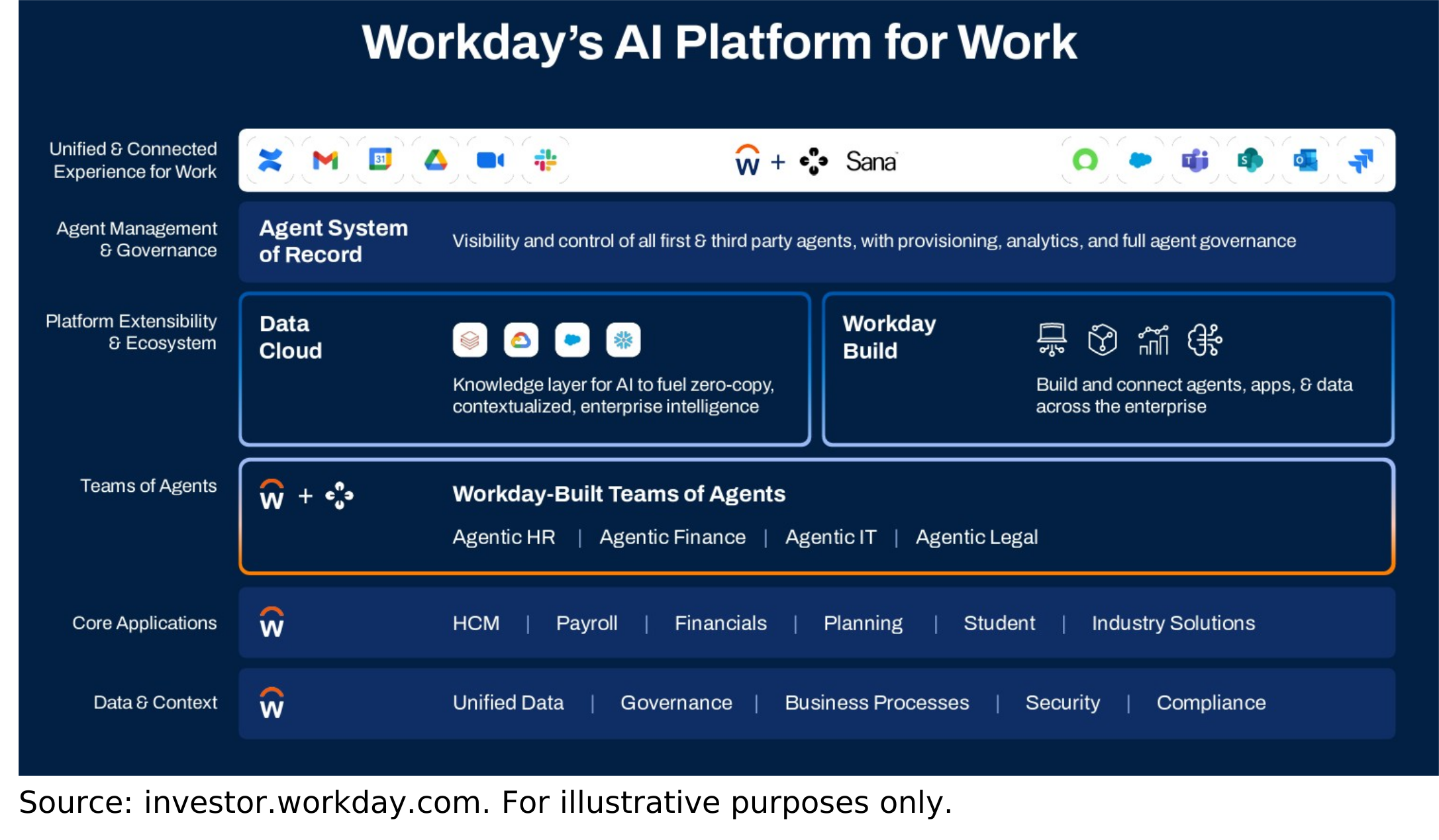
How We Frame Risk

For every company we own, we weigh valuation and risk together. We measure risk through our fundamental risk rating framework that considers balance sheet, business quality, and governance. Workday performs well on that scale. It has a net-cash balance sheet and a strong cash flow profile. The business is high quality with sticky customers, revenue growth well above the broader economy, improving trends in net new bookings, high incremental margins, and an oligopolistic position at the high end of the enterprise market. Governance has been a risk we have watched closely, but the trend is positive. Although stock-based compensation is high, it has come down over time and the buyback has grown. In Q1 of 2026, repurchases reduced the share count by an impressive annualized rate in the mid-teens. On M&A, the company’s growth strategy remains organic-first, consistent with co-founder and CEO Aneel Bhusri’s view that enduring companies are not built through large acquisitions.
How We Think About Value

We think Workday offers limited downside and meaningful upside. Our valuation work starts with the downside; we always ask ourselves how much we could lose if we are wrong. In our discounted cash flow model, Workday’s current share price implies punitive outcomes that include mid-single-digit terminal revenue declines five years out and margins that are similar to other scaled enterprise software incumbents. These assumptions are worse than our downside case. If Workday does face a future of terminal decline like this, we think its margin could be much higher. Financial buyers routinely operate mature, deeply embedded software businesses in run-off mode at operating margins in the mid-60s% or above, not the high-30s%.

The backlog lens is even simpler. Workday’s remaining performance obligations — contracted revenue due even if the company signs no new business or any renewals — exceed its enterprise value. In a run-off scenario, simply collecting the gross-profit stream from existing backlog would make the current stock price roughly fair after considering the roughly offsetting impacts of time-value-of-money and net operating losses. By comparison, other incumbent application software peers trade at multiples of backlog, which implies a healthy slug of terminal growth. In Q1 of 2026, Workday’s backlog grew in the low-teens and the share count declined at an annualized rate in the mid-teens. This means the run-off value on a per share basis grew well in excess of 20%. While there is no guarantee these trends will continue, companies trading near liquidation value rarely enjoy this kind of value-per-share growth. Signs point to this growth continuing, with management flagging Q1 of 2026 as the best first quarter of net new bookings growth in five years, and the potential for net new bookings growth to accelerate in coming quarters.

While the downside is limited in even highly punitive downside scenarios, upside could be substantial. Our base case forecast assumes low-double-digit revenue growth for the intermediate term, gradual maturation toward GDP-like growth over the longer term, and a normal margin profile similar to large public software incumbents. Using these assumptions in our discounted cash flow model gets us to at least a double and plausibly a triple from today’s stock price. More optimistically, if Workday’s agentic opportunity scales and revenue indeed accelerates at high incremental margins, fair value becomes an even larger multiple of today’s stock price.1

Conclusion

While all software is not created equal, AI is more likely a tailwind than a headwind to Workday. Workday has demonstrated strong customer retention, long contracts, a mission-critical role in HR and finance workflows, a credible agentic strategy, improving governance, and a valuation that already discounts extreme disruption. In our view, Workday stands out as one of our best ideas, given its low valuation and attractive risk profile.
 

1There is no guarantee forecasts will be achieved. Actual results may vary substantially.

______________________________________

All investments contain risk and may lose value. This material is for general information purposes and should not be used as the sole basis to make any investment decision. Views expressed are not intended to be relied upon as research regarding a particular industry, investment or the markets in general, nor is it intended to predict performance of any investment or serve as a recommendation to buy or sell securities.

The portfolio manager’s views and opinions expressed are subject to change without notice and may differ from others in the firm, or the firm as a whole. The portfolio manager’s comments may include estimated and/or forecasted views, which are believed to be based on reasonable assumptions within the bounds of current and historical information. Due to various risks and uncertainties, actual events/results or performance may differ materially from those reflected or contemplated in such forward-looking statements. Nothing contained herein may be relied upon as a guarantee, promise, assurance or a representation as to the future. In the event of new information or changed circumstances, Hotchkis & Wiley (“H&W“) reserves the right to change its investment perspective and outlook and has no obligation to provide revised assessments and/or opinions. H&W is not responsible for any damages or losses arising from any use of this information. Information obtained from independent sources is considered reliable, but H&W cannot guarantee its accuracy or completeness.

The security highlighted is for illustrative purposes only and is not an investment recommendation. The security was selected based on non-performance based criteria and its ability to demonstrate and better explain our investment process since the security meets our stringent value and risk criteria. The security was selected from one or more of our strategies and represents only a small portion of the respective strategy’s holdings. The security does not represent all of the securities purchased, sold, or recommended for advisory clients, and may not be indicative of current or future investments. No assumptions should be made that the security highlighted, or all investment decisions were, or will be profitable.  Specific investment advice references provided herein are for illustrative purposes only and are not necessarily representative of investments that will be made in the future.

Artificial Intelligence (AI); Application Programming Interface (API) tiering is the practice of dividing access to an API into distinct levels—or tiers—based on usage volume, feature availability, cost, or performance; Bear is an investor who expects a security or market to decline and often uses strategies like short selling to profit from that downturn; Consumption-based pricing (also known as usage-based or pay-as-you-go pricing) is a model where customers are charged based on their actual consumption of a product or service rather than a flat monthly fee; Gross Domestic Product (GDP) quantifies the overall economic activity and strength of a country by calculating the monetary value of all finished goods and services produced within its borders in a specific timeframe; Gross Revenue Retention (GRR), also known as Gross Dollar Retention (GDR) measures the percentage of recurring revenue that is retained over a specific period of time. GRR captures lost recurring revenue due to customers leaving or lowering their usage commitments; Run-off describes the natural decline of a portfolio's assets because the proceeds from maturing, expiring, or repaid securities are not reinvested; Seat-based revenue (or per-user pricing) is a model where a business charges customers a recurring, flat fee for every individual user or "seat" that accesses their software or service; and White-collar worker typically works in an office setting, performing administrative or managerial tasks.

As of March 31, 2026, Workday Inc. was held in our Large Cap Fundamental Value, Large Cap Disciplined Value, Mid-Cap Value, Value Opportunities, Global Value, and other strategies. A complete list of portfolio holdings is available upon request.

Investing in equity securities have greater risks and price volatility than U.S. Treasuries and bonds, where the price of these securities may decline due to various company, industry, and market factors. Investing in foreign as well as emerging markets involves additional risk such as greater volatility, political, economic, and currency risks and differences in accounting methods. Investing in smaller, medium-sized and/or newer companies involves greater risks not associated with investing in large company stocks, such as business risk, significant stock price fluctuations and illiquidity.

A value-oriented investment approach involves the risk that value stocks may remain undervalued or may not appreciate in value as anticipated. Value stocks can perform differently from the market as a whole or from other types of stocks and may be out of favor with investors and underperform growth stocks for varying periods of time.

Except where otherwise indicated, the information contained in this presentation is based on matters as they exist as of the date of preparation of such material and not as of the date of distribution or any future date. Recipients should not rely on this material in making any future investment decision.

Principal Risks Disclosure for the firm’s strategies are described in Part 2A of Form ADV of H&W.

Past performance is not indicative of future performance.

©2026 Hotchkis & Wiley. All rights reserved. No portions may be published, reproduced or transmitted in any form without the express written permission of H&W.

(click on thumbnail to view)

___________________________________________

You should consider the Hotchkis & Wiley Funds' investment objectives, risks, and charges and expenses carefully before you invest. This and other important information is contained in the Funds' summary prospectus and prospectus, which can be obtained by calling 800-796-5606. Read carefully before you invest.

Mutual fund investing involves risk. Principal loss is possible.
The Hotchkis & Wiley Funds are distributed by Quasar Distributors, LLC

________________________________________

All investments contain risk and may lose value. This video is for general information only and should not be relied on for investment advice or recommendation of any particular security, strategy, or investment product.

Specific company references provided herein are for illustrative purposes only and are not necessarily representative of investments that will be made in the future. Diversification does not protect from risk and does not ensure a profit.                                                                                                                                

The portfolio manager’s views and opinions expressed are as of May 20, 2026. Such views are subject to change without notice and may differ from others in the firm, or the firm as a whole. The portfolio manager’s comments may include estimated and/or forecasted views, which are believed to be based on reasonable assumptions within the bounds of current and historical information. However, there is no guarantee that any estimates, forecasts or views will be realized. Any discussion or view of a security, an asset class/segment, industry/sector and/or investment type is for illustration purposes only and should not be considered as investment recommendations, should not be assumed to be profitable, and are subject to change without notice. In the event of new information or changed circumstances, H&W reserves the right to change its investment perspective and outlook and has no obligation to provide revised assessments and/or opinions.

Investing in foreign as well as emerging markets involves additional risk such as greater volatility, political, economic, and currency risks and differences in accounting methods. A value-oriented investment approach involves the risk that value stocks may remain undervalued or may not appreciate in value as anticipated. Value stocks can perform differently from the market as a whole or from other types of stocks and may be out of favor with investors and underperform growth stocks for varying periods of time.

The S&P 500® Index is a broad-based unmanaged index of 500 stocks, which is widely recognized as representative of the equity market in general.

Principal Risks Disclosure for the firm’s strategies are described in Part 2A of Form ADV of H&W.

Information obtained from independent sources is considered reliable, but H&W cannot guarantee its accuracy or completeness. Certain information contained in this material represents or is based upon forward-looking statements. Due to various risks and uncertainties, actual events/results or performance may differ materially from those reflected or contemplated in such forward-looking statements. Nothing contained herein may be relied upon as a guarantee, promise, assurance or a representation as to the future. H&W is not responsible for any damages or losses arising from any use of this information.

Past performance is not indicative of future performance.

©2026 Hotchkis & Wiley. All rights reserved. No portion of this video may be published, reproduced or transmitted in any form without the express written permission of H&W.

(click on thumbnail to view)

___________________________________________

You should consider the Hotchkis & Wiley Funds' investment objectives, risks, and charges and expenses carefully before you invest. This and other important information is contained in the Funds' summary prospectus and prospectus, which can be obtained by calling 800-796-5606. Read carefully before you invest.

Mutual fund investing involves risk. Principal loss is possible.
The Hotchkis & Wiley Funds are distributed by Quasar Distributors, LLC