Portfolio Manager Patrick Meegan reviews:
- Performance drivers in Q3 2025
- Declining SMID exposure
- Senior secured bond exposure
- Key sector weights
- Current assessment of high yield fundamentals, technicals, and valuation
Portfolio Manager Patrick Meegan reviews:
________________________________________
The performance data quoted represents past performance and does not guarantee future results. Current performance may be lower or higher. Investment return and principal value of the fund will fluctuate, and shares may be worth more or less than their original cost when redeemed. To obtain performance data current to the most recent month-end, access our website at www.hwcm.com.
Hotchkis & Wiley High Yield Fund standardized performance - from the dropdown menu, select month-end or quarter-end standardized fund performance. Click here for the standard yield.
You should consider the Hotchkis & Wiley High Yield Fund’s investment objectives, risks, and charges and expenses carefully before you invest. This and other important information is contained in the Fund's summary prospectus and prospectus, which can be obtained by calling 800-796-5606. Read carefully before you invest.
Investments in debt securities involve credit risk and typically decrease in value when interest rates rise. Investments in lower rated and non rated securities involve greater risk. The fund may invest in derivatives, asset backed and mortgage backed securities, and foreign securities. Please read the fund prospectus for a full list of fund risks.
This material is for general information purposes and should not be used as the sole basis to make any investment decision. Views expressed are not intended to be relied upon as research regarding a particular industry, investment or the markets in general, nor is it intended to predict performance of any investment or serve as a recommendation to buy or sell securities. Hotchkis & Wiley (“H&W”) is not responsible for any damages or losses arising from any use of this information.
The portfolio manager’s views and opinions expressed are as of October 24, 2025. Such views are subject to change without notice and may differ from others in the firm, or the firm as a whole. The portfolio manager’s comments may include estimated and/or forecasted views, which are believed to be based on reasonable assumptions within the bounds of current and historical information. However, there is no guarantee that any estimates, forecasts or views will be realized. In the event of new information or changed circumstances, H&W reserves the right to change its investment perspective and outlook and has no obligation to provide revised assessments and/or opinions.
Information obtained from independent sources is considered reliable, but H&W cannot guarantee its accuracy or completeness. Certain information contained in this material represents or is based upon forward-looking statements. Due to various risks and uncertainties, actual events/results or performance may differ materially from those reflected or contemplated in such forward-looking statements. Nothing contained herein may be relied upon as a guarantee, promise, assurance or a representation as to the future.
Spread usually refers to the difference between two prices (the bid and the ask) of a security or asset, or between two similar assets; Duration measures the price sensitivity of a bond to interest rate movements; Basis Points is a unit equal to 1/100th of 1% and is used to denote the change in a financial instrument; Tariffs are taxes imposed by one country on goods imported from another country; Collateralized Loan Obligation (CLO) is a securitization product created to acquire and manage a pool of leveraged loans; Investment Grade (IG) is a rating that signifies a municipal or corporate bond presents a relatively low risk of default; High Grade Credit refers to investment-grade debt instruments, particularly bonds, issued by entities (corporations or governments) considered to have a low risk of default; Alpha is the excess return on an investment after adjusting for market-related volatility and random fluctuations; Capital Expenditure (CapEx) the payment with either cash or credit to purchase long-term physical or fixed assets used in a business's operations; Real Estate Investment Trust (REIT) is a company that owns, operates, or finances income-generating real estate and sells shares to raise capital to do so; and Gross Domestic Product (GDP) measures the total value of everything a country produces in goods and services over a set period.
Top ten holdings as of 3/31/26 as a % of the Fund’s net assets: CCO Holdings LLC 2.6%, UKG Inc. 1.5%, W.R. Grace Hldgs LLC 1.3%, Carnival Corp. 1.2%, Boardriders Inc. 1.2%, TransDigm Inc. 1.0%, Societe Generale SA 1.0%, Cyprium Corp. 1.0%, Lloyds Banking Grp PLC 1.0%, and SCIL IV LLC / SCIL USA Holdgs LLC 1.0%. Fund holdings and/or sector allocations are subject to change and are not recommendations to buy or sell any security. Diversification does not assure a profit nor protect against loss in a declining market.
Fundamental Risk Ratings: As part of the research process, the risk profile of each security is discussed and scored. Risk scores are balanced against the valuation. Scores influence buy/sell decision and position sizing (1 = Best, 5 = Worst).
The ICE BofA BB-B US High Yield Constrained Index contains all securities in the ICE BofA US High Yield Index rated BB+ through B- by S&P (or equivalent as rated by Moody’s or Fitch), but caps issuer exposure at 2%. Index constituents are capitalization weighted, based on their current amount outstanding, provided the total allocation to an individual issuer does not exceed 2%. Unless otherwise noted, “high yield” market refers to the ICE BofA US High Yield Index. The ICE BofA US High Yield Index tracks the performance of below investment grade, but not in default, US dollar-denominated corporate bonds publicly issued in the US domestic market, and includes issues with a credit rating of BBB or below, as rated by Moody’s, Fitch and S&P. The indices do not reflect the payment of transaction costs, fees and expenses associated with an investment in the Fund. It is not possible to invest directly in an index.
Bond ratings are grades given to bonds that indicate their credit quality as determined by private independent rating services such as Standard & Poor's, Moody's and Fitch. These firms evaluate a bond issuer's financial strength, or its ability to pay a bond's principal and interest in a timely fashion. Ratings are expressed as letters ranging from 'AAA', which is the highest grade, to 'D', which is the lowest grade. Investment Grade includes credits that are BBB- or above.
Past performance is not indicative of future performance.
Mutual fund investing involves risk. Principal loss is possible.
The Hotchkis & Wiley Funds are distributed by Quasar Distributors, LLC
©2026 Hotchkis & Wiley. All rights reserved. No portion of this podcast may be published, reproduced or transmitted in any form without the express written permission of H&W.
(click on thumbnail to view newsletter)
________________________________________
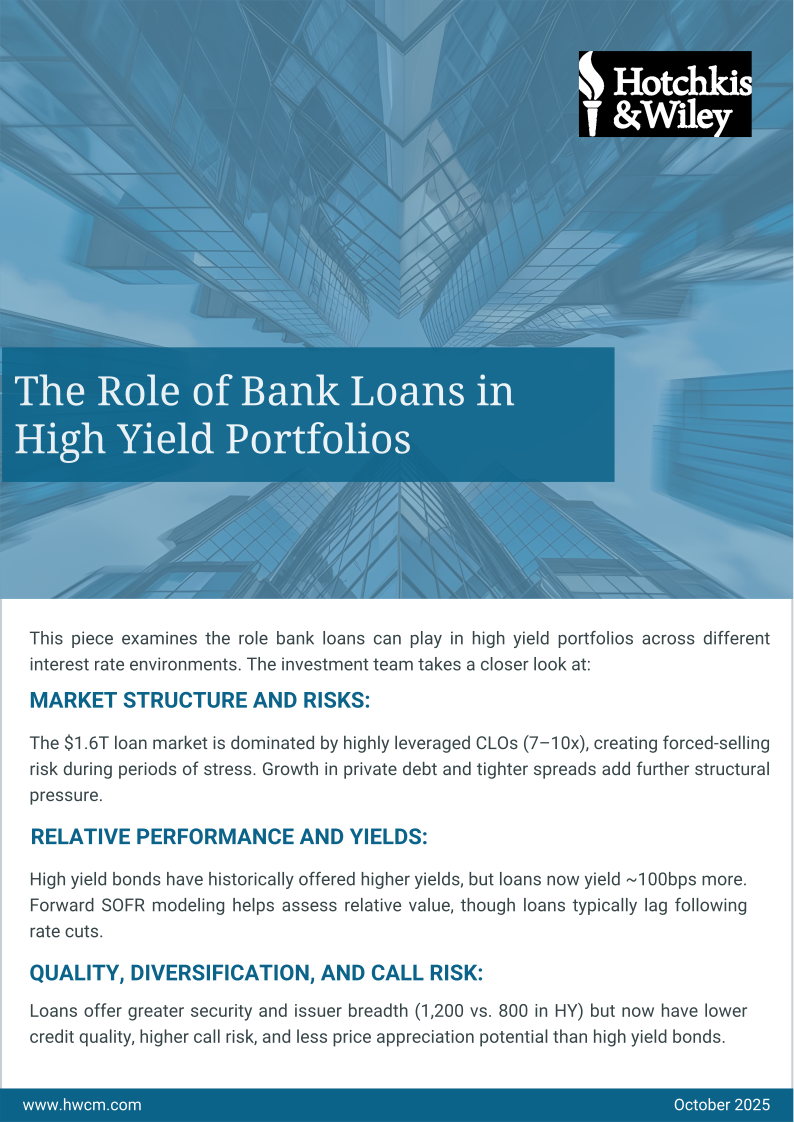
All investments contain risk and may lose value. This material is for general information purposes and should not be used as the sole basis to make any investment decision. Views expressed are not intended to be relied upon as research regarding a particular industry, investment or the markets in general, nor is it intended to predict performance of any investment or serve as a recommendation to buy or sell securities.
Investing in high yield securities is subject to certain risks, including market, credit, liquidity, issuer, interest-rate, inflation, and derivatives risks. Lower-rated and non-rated securities involve greater risk than higher-rated securities. Investing in debt securities typically decreases in value when interest rates rise. This risk is usually greater for longer-term debt securities; Secured Overnight Financing Rate (SOFR); Collateralized Loan Obligations (CLOs); and Spread is the % point difference between yields of various classes of bonds compared to treasury bonds.
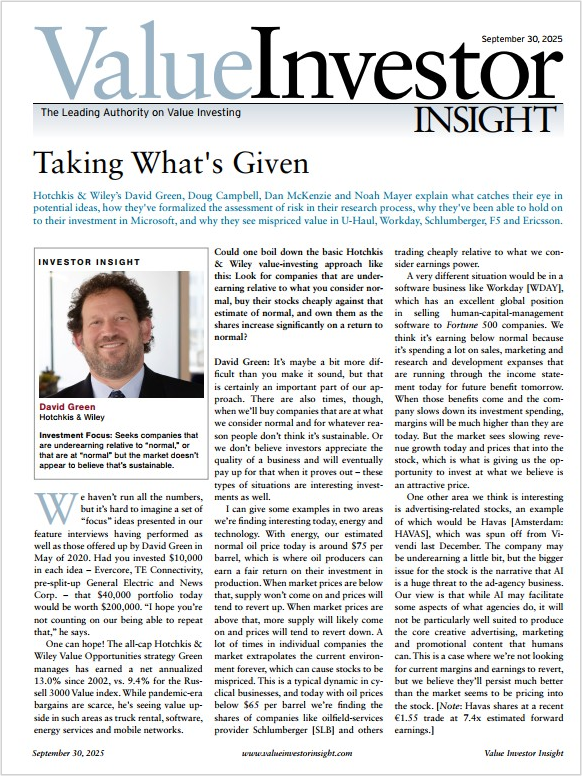
The team provides an update on what’s new in Value Opportunities, emphasizing:
(click on thumbnail to view article)
________________________________________
All investments contain risk and may lose value. Past performance is not indicative of future performance. This article is for general information only and should not be relied on for investment advice or recommendation of any particular security, strategy, or investment product.
The portfolio manager’s views and opinions expressed in this article are as of September 30, 2025. Such views are subject to change without notice and may differ from others in the firm, or the firm as a whole. The portfolio manager’s comments may include estimated and/or forecasted views, which are believed to be based on reasonable assumptions within the bounds of current and historical information. However, there is no guarantee that any estimates, forecasts or views will be realized. The article may also contain views that are forward-looking statements. Due to various risks and uncertainties, actual events/results or the performance of the Value Opportunities strategy may differ materially from those reflected or contemplated in such forward-looking statements.

Investment returns include reinvestment of dividends, interest and capital gains. Valuation is based on trade-date information and stated in U.S. dollars. Net performance results are presented after actual management fees and all trading expenses but before custodial fees. The Value Opportunities strategy’s returns for different time periods and market cycles can result in significantly different performance results. An account’s investment guidelines, timing of transactions, market conditions at the time of investment and other factors may lead to different performance results. The Composite includes all Value Opportunities discretionary accounts. The Value Opportunities strategy seeks capital appreciation primarily through investments in equity securities, such as common stock, preferred stock and convertible securities, of any size market capitalization, and investment grade and high yield (“junk bonds”) fixed income securities. Companies that is believed to have strong capital appreciation potential and may invest in foreign (non-U.S.) securities. Additional performance disclosures are included in the strategy’s GIPS Report.
The securities highlighted in this article are intended to be for illustrative purposes only. Any discussion or view of a security, an asset class/segment, industry/sector and/or investment type are not investment recommendations, should not be assumed to be profitable, and are subject to change without notice. There is no assurance that the securities discussed will remain in the portfolio or that securities sold have not been repurchased. The securities discussed do not represent the entire portfolio and may only represent a small portion of the portfolio. In the event of new information or changed circumstances, H&W reserves the right to change its investment perspective and outlook and has no obligation to provide revised assessments and/or opinions.
Holdings and/or characteristics are based on a representative portfolio of the Value Opportunities Strategy. This information may vary by portfolio due to different restrictions, cash flows, and other relevant considerations. H&W selected the representative portfolio based on non-performance criteria. The representative portfolio reflects the management style of the strategy, is part of the strategy’s composite, and has the longest duration under the Adviser’s discretion. Selection of the representative portfolio considers one or more of the following factors, such as the portfolio’s investment guidelines/restrictions, cash flow activity, or duration under the Adviser’s discretion. The representative portfolio is used for informational purposes only, does not predict future portfolio characteristics, and may differ from other portfolios in the strategy due to asset size, client guidelines, and other variables.
The Russell 3000® Value Index includes stocks from the Russell 3000® Index with lower price-to-book ratios and lower expected growth rates. The S&P 500® Index is a broad-based unmanaged index of 500 stocks, which is widely recognized as representative of the equity market in general. The indexes assume reinvestment of dividends and capital gains, and assume no management, custody, transaction or other expenses. Russell Investment Group is the source and owner of the Russell Index data contained herein (and all trademarks related thereto), which may not be redistributed. The information herein is not approved by Russell. H&W and Russell sectors are based on the Global Industry Classification Standard by MSCI and S&P. It is not possible to invest directly in an index.
Investing in foreign as well as emerging markets involves additional risk such as greater volatility, political, economic, and currency risks and differences in accounting methods. Investing in smaller, medium-sized and/or newer companies involves greater risks not associated with investing in large company stocks, such as business risk, significant stock price fluctuations and illiquidity. Investing in debt securities typically decreases in value when interest rates rise. This risk is usually greater for longer-term debt securities. A value-oriented investment approach involves the risk that value stocks may remain undervalued or may not appreciate in value as anticipated. Value stocks can perform differently from the market as a whole or from other types of stocks and may be out of favor with investors and underperform growth stocks for varying periods of time. Principal Risks Disclosure for the firm’s strategies are described in Part 2A of Form ADV of H&W.
©2026 Hotchkis & Wiley. All rights reserved. No portion of the article may be published, reproduced, transmitted or rebroadcast in any form without the express written permission of H&W.
H&W CEO and Portfolio Manager Scott McBride recently provided an update on the Large Cap Fundamental Value portfolio, covering year-to-date performance, key performance drivers, and notable portfolio performance drivers and positioning changes over the five years ended September 30, 2025.
________________________________________
The performance data quoted represents past performance and does not guarantee future results. Current performance may be lower or higher. Investment return and principal value of the fund will fluctuate, and shares may be worth more or less than their original cost when redeemed. To obtain performance data current to the most recent month-end, access our website at www.hwcm.com.
Hotchkis & Wiley Large Cap Fundamental Value Fund standardized performance - from the dropdown menu, select month-end or quarter-end standardized fund performance
You should consider the Hotchkis & Wiley Large Cap Fundamental Value Fund’s investment objectives, risks, and charges and expenses carefully before you invest. This and other important information is contained in the Fund's summary prospectus and prospectus, which can be obtained by calling 800-796-5606. Read carefully before you invest.
The Fund may invest in foreign and emerging markets securities, which subjects the Fund to increased risk. Please read the fund prospectus for a full list of fund risks. All investments contain risk and may lose value. Equities, bonds, and other asset classes have different risk profiles, which should be considered when investing.
This material is for general information purposes and should not be used as the sole basis to make any investment decision. Views expressed are not intended to be relied upon as research regarding a particular industry, investment or the markets in general, nor is it intended to predict performance of any investment or serve as a recommendation to buy or sell securities. Hotchkis & Wiley (“H&W”) is not responsible for any damages or losses arising from any use of this information.
The portfolio manager’s views and opinions expressed are as of October 1, 2025. Such views are subject to change without notice and may differ from others in the firm, or the firm as a whole. The portfolio manager’s comments may include estimated and/or forecasted views, which are believed to be based on reasonable assumptions within the bounds of current and historical information. However, there is no guarantee that any estimates, forecasts or views will be realized. In the event of new information or changed circumstances, H&W reserves the right to change its investment perspective and outlook and has no obligation to provide revised assessments and/or opinions.
Information obtained from independent sources is considered reliable, but H&W cannot guarantee its accuracy or completeness. Certain information contained in this material represents or is based upon forward-looking statements. Due to various risks and uncertainties, actual events/results or performance may differ materially from those reflected or contemplated in such forward-looking statements. Nothing contained herein may be relied upon as a guarantee, promise, assurance or a representation as to the future.
Click on link for top ten Fund holdings: Hotchkis & Wiley Large Cap Fundamental Value Fund. Fund holdings are subject to change and are not recommendations to buy or sell any security. Diversification does not assure a profit nor protect against loss in a declining market.
AI - Artificial Intelligence; DSL – Digital Subscriber Line; ERP – Enterprise Resource Planning; GE – General Electric; HCM – Human Capital Management; R&D – Research and Development; ROE – Return on Equity; Buyback is when a company buys back its own shares from the stock market. Fundamental Risk Ratings based on H&W internal analysis. Payout Yield is the total value of payments an investor receives from an investment, expressed as a percentage of the investment's value. Price-to-Earnings (P/E) ratio measures a company's share price relative to its earnings per share (EPS). SaaS - Software as a Service.
The Russell 1000® Index measures the performance of the large-cap segment of the US equity universe. The Russell 1000® Value Index measures the performance of those Russell 1000® companies with lower price-to-book ratios and lower forecasted growth values. The S&P 500® Index is a broad-based unmanaged index of 500 stocks, which is widely recognized as representative of the equity market in general. The indices do not reflect the payment of transaction costs, fees and expenses associated with an investment in the Fund. The Fund’s value disciplines may prevent or restrict investment in major stocks in the benchmark indices. It is not possible to invest directly in an index.
Past performance is not indicative of future performance.
Mutual fund investing involves risk. Principal loss is possible.
The Hotchkis & Wiley Funds are distributed by Quasar Distributors, LLC
©2026 Hotchkis & Wiley. All rights reserved. No portion of this podcast may be published, reproduced or transmitted in any form without the express written permission of H&W.