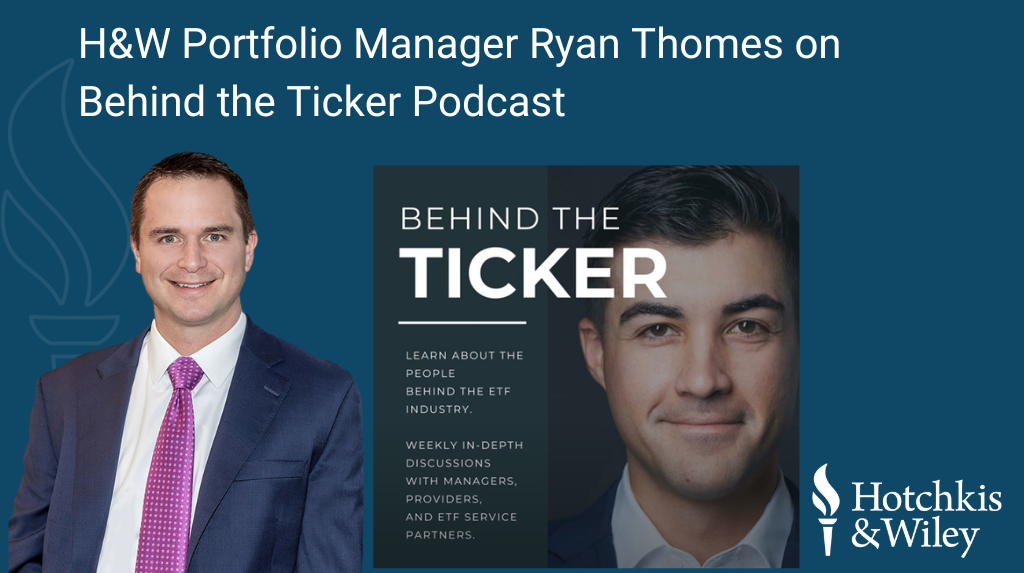
H&W CEO and Portfolio Manager Scott McBride recently provided an update on the Large Cap Fundamental Value portfolio, covering year-to-date performance, key performance drivers, and notable portfolio performance drivers and positioning changes over the five years ended September 30, 2025.


________________________________________

The performance data quoted represents past performance and does not guarantee future results. Current performance may be lower or higher. Investment return and principal value of the fund will fluctuate, and shares may be worth more or less than their original cost when redeemed. To obtain performance data current to the most recent month-end, access our website at www.hwcm.com.

Hotchkis & Wiley Large Cap Fundamental Value Fund standardized performance - from the dropdown menu, select month-end or quarter-end standardized fund performance

You should consider the Hotchkis & Wiley Large Cap Fundamental Value Fund’s investment objectives, risks, and charges and expenses carefully before you invest. This and other important information is contained in the Fund's summary prospectus and prospectuswhich can be obtained by calling 800-796-5606. Read carefully before you invest.

The Fund may invest in foreign and emerging markets securities, which subjects the Fund to increased risk. Please read the fund prospectus for a full list of fund risks.  All investments contain risk and may lose value. Equities, bonds, and other asset classes have different risk profiles, which should be considered when investing.    

This material is for general information purposes and should not be used as the sole basis to make any investment decision. Views expressed are not intended to be relied upon as research regarding a particular industry, investment or the markets in general, nor is it intended to predict performance of any investment or serve as a recommendation to buy or sell securities. Hotchkis & Wiley (“H&W”) is not responsible for any damages or losses arising from any use of this information.

The portfolio manager’s views and opinions expressed are as of October 1, 2025. Such views are subject to change without notice and may differ from others in the firm, or the firm as a whole. The portfolio manager’s comments may include estimated and/or forecasted views, which are believed to be based on reasonable assumptions within the bounds of current and historical information. However, there is no guarantee that any estimates, forecasts or views will be realized. In the event of new information or changed circumstances, H&W reserves the right to change its investment perspective and outlook and has no obligation to provide revised assessments and/or opinions.

Information obtained from independent sources is considered reliable, but H&W cannot guarantee its accuracy or completeness. Certain information contained in this material represents or is based upon forward-looking statements. Due to various risks and uncertainties, actual events/results or performance may differ materially from those reflected or contemplated in such forward-looking statements. Nothing contained herein may be relied upon as a guarantee, promise, assurance or a representation as to the future.

Click on link for top ten Fund holdings: Hotchkis & Wiley Large Cap Fundamental Value Fund. Fund holdings are subject to change and are not recommendations to buy or sell any security. Diversification does not assure a profit nor protect against loss in a declining market.

AI - Artificial Intelligence; DSL – Digital Subscriber Line; ERP – Enterprise Resource Planning; GE – General Electric; HCM – Human Capital Management; R&D – Research and Development; ROE – Return on Equity; Buyback is when a company buys back its own shares from the stock market. Fundamental Risk Ratings based on H&W internal analysis. Payout Yield is the total value of payments an investor receives from an investment, expressed as a percentage of the investment's value. Price-to-Earnings (P/E) ratio measures a company's share price relative to its earnings per share (EPS). SaaS - Software as a Service.

The Russell 1000® Index measures the performance of the large-cap segment of the US equity universe. The Russell 1000® Value Index measures the performance of those Russell 1000® companies with lower price-to-book ratios and lower forecasted growth values. The S&P 500® Index is a broad-based unmanaged index of 500 stocks, which is widely recognized as representative of the equity market in general. The indices do not reflect the payment of transaction costs, fees and expenses associated with an investment in the Fund. The Fund’s value disciplines may prevent or restrict investment in major stocks in the benchmark indices. It is not possible to invest directly in an index.

Past performance is not indicative of future performance.

Mutual fund investing involves risk. Principal loss is possible.

The Hotchkis & Wiley Funds are distributed by Quasar Distributors, LLC

©2026 Hotchkis & Wiley. All rights reserved. No portion of this podcast may be published, reproduced or transmitted in any form without the express written permission of H&W.

Executive Summary and Context

Artificial intelligence (AI) continues to be a central topic for investors in the application software sector. The past 12 months have brought a wave of speculation around AI-driven disruption, particularly with the emergence of large language models (LLMs) and AI agents. While some commentators predict existential threats to incumbent software vendors, we believe this outlook is overstated. Our research suggests that while AI will influence enterprise software, the disruption will be incremental and manageable for companies with deep, multidimensional moats.

This report outlines the four core arguments of the AI bear case and offers our perspective on why entrenched vendors like Workday remain well positioned. Meanwhile, software vendors that rely more heavily on user interface familiarity and are less embedded in enterprise workflows, face greater near-term risk.

Key themes examined include:

1.   AI agents and seat-based pricing pressure

2.   AI-native coding tools and barriers to entry

3.   Application design for human users vs. AI workflows

4.   AI disintermediation of business logic and data access

Each of these points introduces specific threats, but they also highlight the resilience of enterprise software models and the pragmatic pace of AI adoption.

Evaluating The First Two AI Bear Arguments

AI Agents Replacing White-Collar Workers

The argument that AI agents will replace large numbers of white-collar workers is currently unsubstantiated by employment data. While LLMs are enhancing productivity in roles like software development, customer service, and recruiting, the evidence points to augmentation rather than replacement. Software developers, for instance, remain in demand, albeit with a shift in job composition1.

Workday’s Recruiter Agent exemplifies AI’s role in freeing up time (2.5 hours/day) rather than eliminating jobs. Even with these efficiency gains, full automation is constrained by tasks AI cannot yet perform, including compliance, mentorship, and decision-making requiring judgment.

Importantly, application software vendors are protected by multi-year contracts and are already adapting seat-based pricing models. For example:

  Workday, and other large software vendors, integrates CPI-based and innovation-linked pricing escalators.

  Usage-based revenue models are being tested, offering flexibility if seat counts decline.

AI-Native Coding Tools and Competitive Entry

The idea that LLM-based development tools like GitHub Copilot or Claude Code will reduce barriers to entry in application software overlooks the broader picture. While these tools cut coding time by up to 50%, actual coding represents only ~5–8% of the Opex required to build an enterprise SaaS platform. In other words, cost savings from faster coding are marginal in the context of building a large-scale software business.

Moreover, incumbents also leverage these tools to accelerate their own innovation. Workday’s expanding portfolio of AI-driven agents demonstrate the ability of established firms to stay ahead.

Crucially, startups face headwinds including:

  Lack of historical customer data, which limits model fine-tuning.

  Disjointed go-to-market channels.

  Preference among CIOs for integrated suites due to compliance, cost, and complexity considerations.

As a result, AI-native startups are often complementary rather than directly competitive with system-of-record vendors like Workday

Structural Resilience of Enterprise Software

Application Design and Human-Centric Interfaces

The third AI bear argument, that enterprise applications will become obsolete as they were built for humans, assumes an unrealistic pace of automation. Most application software is structured in three layers: user interface, business logic, and data schema. While user interfaces may evolve with AI prompting capabilities, replacing the underlying business logic and data models is a non-trivial task.

User interface familiarity also provides friction to switching, especially for power users. For example, graphic design products typically enjoy strong user lock-in, but they are more vulnerable to interface disruption than vendors like Workday, whose moat relies more heavily on complex business logic, regulatory, and compliance functionality.

More importantly, business logic and data schemas have been designed to serve human workflows. Replacing these workflows with AI agents would require significant redesign, which is costly, risky, and often unnecessary. Workday’s single-codebase and clean data architecture allow it to iterate quickly in response to new demands, offering a structural advantage over more fragmented competitors.

Data Access and the Role of AI Agents

The fourth and most speculative bear case contends that AI agents will eventually replicate the business logic encoded in software, leaving software vendors as mere data repositories. While conceptually appealing, this thesis overlooks several real-world constraints:

•  Immaturity of AI agents: Current systems struggle with multistep workflows and error accumulation.

•  Data complexity: Each vendor’s data schema is unique. AI agents would need to replicate proprietary logic just to interpret data meaningfully.

•  Control over access: Incumbent vendors can and do restrict API access to protect their IP and client data. Glean, for example, has already faced such throttling by multiple software vendors.

•  Regulatory and audit requirements: Mission-critical workflows (e.g., SOX compliance) demand deterministic outcomes and robust access controls.

For now, enterprises will remain cautious about replacing trusted applications with unpredictable AI systems. The “blast radius” of errors in multi-agent systems accessing sensitive data is too high a risk for most firms to accept, especially in mission-critical back office functions like HR and Finance.

Implications and Outlook

While generative AI is already reshaping aspects of software usage and development, claims of wholesale disruption are premature. We believe the more likely outcome is one of augmentation, not replacement. Enterprises will adopt AI tools to boost productivity and enhance workflows, but they will do so with measured caution, especially in regulated or data-sensitive domains.

As such, we view Workday as particularly well positioned:

•  Strong product suite across HR and Finance

•  High gross retention (~98%)

•  Single data model and fast innovation cycles

•  Deep business logic integration and enterprise trust

The emergence of LLMs and AI agents introduces new dynamics to enterprise software markets. However, the structural advantages held by incumbent vendors including contractual lock-in, data control, embedded business logic, and regulatory compliance offer significant protection against disruption. We believe firms investing in AI proactively, while maintaining trust and security, will likely emerge stronger, not weaker, in the AI era.

Hotchkis & Wiley Research
 

1Empirical Research Partners Analysis, May 2025
______________________________________

You should consider the Hotchkis & Wiley Funds’ investment objectives, risks, and charges and expenses carefully before you invest. This and other important information is contained in the Funds’ summary prospectus and prospectus, which can be obtained by calling 800-796-5606. Read carefully before you invest.

The portfolio manager’s views and opinions expressed are subject to change without notice and may differ from others in the firm, or the firm as a whole. The portfolio manager’s comments may include estimated and/or forecasted views, which are believed to be based on reasonable assumptions within the bounds of current and historical information. Due to various risks and uncertainties, actual events/results or performance may differ materially from those reflected or contemplated in such forward-looking statements. Nothing contained herein may be relied upon as a guarantee, promise, assurance or a representation as to the future. In the event of new information or changed circumstances, Hotchkis & Wiley (“H&W“) reserves the right to change its investment perspective and outlook and has no obligation to provide revised assessments and/or opinions. H&W is not responsible for any damages or losses arising from any use of this information. Information obtained from independent sources is considered reliable, but H&W cannot guarantee its accuracy or completeness.

Click on the respective link for Top Ten Fund holdingsHotchkis & Wiley Large Cap Disciplined Value Fund, Hotchkis & Wiley Mid-Cap Value Fund, Hotchkis & Wiley Value Opportunities Fund, and Hotchkis & Wiley Global Value Fund. Fund holdings are subject to change and are not recommendations to buy or sell any security. Diversification does not assure a profit nor protect against loss in a declining market.

CPI - Consumer Price Index; API - Application Programming Interface; IP - Internet Protocol address; SaaS - Software as a Service; SOX compliance - requirements established by the Sarbanes-Oxley Act of 2002, which aims to protect investors by improving the accuracy and reliability of financial reporting in public

Investing in equity securities have greater risks and price volatility than U.S. Treasuries and bonds, where the price of these securities may decline due to various company, industry, and market factors. Investing in foreign as well as emerging markets involves additional risk such as greater volatility, political, economic, and currency risks and differences in accounting methods. Investing in smaller, medium-sized and/or newer companies involves greater risks not associated with investing in large company stocks, such as business risk, significant stock price fluctuations and illiquidity.

A value-oriented investment approach involves the risk that value stocks may remain undervalued or may not appreciate in value as anticipated. Value stocks can perform differently from the market as a whole or from other types of stocks and may be out of favor with investors and underperform growth stocks for varying periods of time.

Past performance is not indicative of future performance.

Mutual fund investing involves risk. Principal loss is possible.
The Hotchkis & Wiley Funds are distributed by Quasar Distributors, LLC

©2026 Hotchkis & Wiley. All rights reserved. No portion may be published, reproduced or transmitted in any form without the express written permission of H&W.

Executive Summary and Context

Artificial intelligence (AI) continues to be a central topic for investors in the application software sector. The past 12 months have brought a wave of speculation around AI-driven disruption, particularly with the emergence of large language models (LLMs) and AI agents. While some commentators predict existential threats to incumbent software vendors, we believe this outlook is overstated. Our research suggests that while AI will influence enterprise software, the disruption will be incremental and manageable for companies with deep, multidimensional moats.

This report outlines the four core arguments of the AI bear case and offers our perspective on why entrenched vendors like Workday remain well positioned. Meanwhile, software vendors that rely more heavily on user interface familiarity and are less embedded in enterprise workflows, face greater near-term risk.

Key themes examined include:

1.   AI agents and seat-based pricing pressure

2.   AI-native coding tools and barriers to entry

3.   Application design for human users vs. AI workflows

4.   AI disintermediation of business logic and data access

Each of these points introduces specific threats, but they also highlight the resilience of enterprise software models and the pragmatic pace of AI adoption.

Evaluating The First Two AI Bear Arguments

AI Agents Replacing White-Collar Workers

The argument that AI agents will replace large numbers of white-collar workers is currently unsubstantiated by employment data. While LLMs are enhancing productivity in roles like software development, customer service, and recruiting, the evidence points to augmentation rather than replacement. Software developers, for instance, remain in demand, albeit with a shift in job composition1.

Workday’s Recruiter Agent exemplifies AI’s role in freeing up time (2.5 hours/day) rather than eliminating jobs. Even with these efficiency gains, full automation is constrained by tasks AI cannot yet perform, including compliance, mentorship, and decision-making requiring judgment.

Importantly, application software vendors are protected by multi-year contracts and are already adapting seat-based pricing models. For example:

  Workday, and other large software vendors, integrates CPI-based and innovation-linked pricing escalators.

  Usage-based revenue models are being tested, offering flexibility if seat counts decline.

AI-Native Coding Tools and Competitive Entry

The idea that LLM-based development tools like GitHub Copilot or Claude Code will reduce barriers to entry in application software overlooks the broader picture. While these tools cut coding time by up to 50%, actual coding represents only ~5–8% of the Opex required to build an enterprise SaaS platform. In other words, cost savings from faster coding are marginal in the context of building a large-scale software business.

Moreover, incumbents also leverage these tools to accelerate their own innovation. Workday’s expanding portfolio of AI-driven agents demonstrate the ability of established firms to stay ahead.

Crucially, startups face headwinds including:

  Lack of historical customer data, which limits model fine-tuning.

  Disjointed go-to-market channels.

  Preference among CIOs for integrated suites due to compliance, cost, and complexity considerations.

As a result, AI-native startups are often complementary rather than directly competitive with system-of-record vendors like Workday.

Structural Resilience of Enterprise Software

Application Design and Human-Centric Interfaces

The third AI bear argument, that enterprise applications will become obsolete as they were built for humans, assumes an unrealistic pace of automation. Most application software is structured in three layers: user interface, business logic, and data schema. While user interfaces may evolve with AI prompting capabilities, replacing the underlying business logic and data models is a non-trivial task.

User interface familiarity also provides friction to switching, especially for power users. For example, graphic design products typically enjoy strong user lock-in, but they are more vulnerable to interface disruption than vendors like Workday, whose moat relies more heavily on complex business logic, regulatory, and compliance functionality.

More importantly, business logic and data schemas have been designed to serve human workflows. Replacing these workflows with AI agents would require significant redesign, which is costly, risky, and often unnecessary. Workday’s single-codebase and clean data architecture allow it to iterate quickly in response to new demands, offering a structural advantage over more fragmented competitors.

Data Access and the Role of AI Agents

The fourth and most speculative bear case contends that AI agents will eventually replicate the business logic encoded in software, leaving software vendors as mere data repositories. While conceptually appealing, this thesis overlooks several real-world constraints:

•  Immaturity of AI agents: Current systems struggle with multistep workflows and error accumulation.

•  Data complexity: Each vendor’s data schema is unique. AI agents would need to replicate proprietary logic just to interpret data meaningfully.

•  Control over access: Incumbent vendors can and do restrict API access to protect their IP and client data. Glean, for example, has already faced such throttling by multiple software vendors.

•  Regulatory and audit requirements: Mission-critical workflows (e.g., SOX compliance) demand deterministic outcomes and robust access controls.

For now, enterprises will remain cautious about replacing trusted applications with unpredictable AI systems. The “blast radius” of errors in multi-agent systems accessing sensitive data is too high a risk for most firms to accept, especially in mission-critical back office functions like HR and Finance.

Implications and Outlook

While generative AI is already reshaping aspects of software usage and development, claims of wholesale disruption are premature. We believe the more likely outcome is one of augmentation, not replacement. Enterprises will adopt AI tools to boost productivity and enhance workflows, but they will do so with measured caution, especially in regulated or data-sensitive domains.

As such, we view Workday as particularly well positioned:

•  Strong product suite across HR and Finance

•  High gross retention (~98%)

•  Single data model and fast innovation cycles

•  Deep business logic integration and enterprise trust

The emergence of LLMs and AI agents introduces new dynamics to enterprise software markets. However, the structural advantages held by incumbent vendors including contractual lock-in, data control, embedded business logic, and regulatory compliance offer significant protection against disruption. We believe firms investing in AI proactively, while maintaining trust and security, will likely emerge stronger, not weaker, in the AI era.

Hotchkis & Wiley Research
 

1Empirical Research Partners Analysis, May 2025
______________________________________

All investments contain risk and may lose value. This material is for general information purposes and should not be used as the sole basis to make any investment decision. Views expressed are not intended to be relied upon as research regarding a particular industry, investment or the markets in general, nor is it intended to predict performance of any investment or serve as a recommendation to buy or sell securities.

The portfolio manager’s views and opinions expressed are subject to change without notice and may differ from others in the firm, or the firm as a whole. The portfolio manager’s comments may include estimated and/or forecasted views, which are believed to be based on reasonable assumptions within the bounds of current and historical information. Due to various risks and uncertainties, actual events/results or performance may differ materially from those reflected or contemplated in such forward-looking statements. Nothing contained herein may be relied upon as a guarantee, promise, assurance or a representation as to the future. In the event of new information or changed circumstances, Hotchkis & Wiley (“H&W“) reserves the right to change its investment perspective and outlook and has no obligation to provide revised assessments and/or opinions. H&W is not responsible for any damages or losses arising from any use of this information. Information obtained from independent sources is considered reliable, but H&W cannot guarantee its accuracy or completeness.

The security highlighted is for illustrative purposes only and is not an investment recommendation. The security was selected based on non-performance based criteria and its ability to demonstrate and better explain our investment process since the security meets our stringent value and risk criteria. The security was selected from one or more of our strategies and represents only a small portion of the respective strategy’s holdings. The security does not represent all of the securities purchased, sold, or recommended for advisory clients, and may not be indicative of current or future investments. No assumptions should be made that the security highlighted, or all investment decisions were, or will be profitable.

As of December 31, 2025, Workday Inc. was held in our Large Cap Fundamental Value, Large Cap Disciplined Value, Mid-Cap Value, Value Opportunities, Global Value, and other strategies. A complete list of portfolio holdings is available upon request.

Investing in equity securities have greater risks and price volatility than U.S. Treasuries and bonds, where the price of these securities may decline due to various company, industry, and market factors. Investing in foreign as well as emerging markets involves additional risk such as greater volatility, political, economic, and currency risks and differences in accounting methods. Investing in smaller, medium-sized and/or newer companies involves greater risks not associated with investing in large company stocks, such as business risk, significant stock price fluctuations and illiquidity.

A value-oriented investment approach involves the risk that value stocks may remain undervalued or may not appreciate in value as anticipated. Value stocks can perform differently from the market as a whole or from other types of stocks and may be out of favor with investors and underperform growth stocks for varying periods of time.

©2026 Hotchkis & Wiley. All rights reserved. No portions may be published, reproduced or transmitted in any form without the express written permission of H&W.

Value Opportunities Portfolio Manager David Green joins the H&W podcast series to provide an update on performance in the first half of 2025, and where he is finding relative valuation opportunities.


________________________________________

The performance data quoted represents past performance and does not guarantee future results. Current performance may be lower or higher. Investment return and principal value of the fund will fluctuate, and shares may be worth more or less than their original cost when redeemed. To obtain performance data current to the most recent month-end, access our website at www.hwcm.com.

Hotchkis & Wiley Value Opportunities Fund standardized performance - from the dropdown menu, select month-end or quarter-end standardized fund performance

You should consider the Hotchkis & Wiley Value Opportunities Fund’s investment objectives, risks, and charges and expenses carefully before you invest. This and other important information is contained in the Fund's summary prospectus and prospectuswhich can be obtained by calling 800-796-5606. Read carefully before you invest.

The fund is non-diversified and may invest in foreign securities, junk bonds, derivatives, or small/mid cap companies.  Please read the fund prospectus for a full list of fund risks.  All investments contain risk and may lose value. Equities, bonds, and other asset classes have different risk profiles, which should be considered when investing.    

This material is for general information purposes and should not be used as the sole basis to make any investment decision. Views expressed are not intended to be relied upon as research regarding a particular industry, investment or the markets in general, nor is it intended to predict performance of any investment or serve as a recommendation to buy or sell securities. Hotchkis & Wiley (“H&W”) is not responsible for any damages or losses arising from any use of this information.

The portfolio manager’s views and opinions expressed are as of July 29, 2025. Such views are subject to change without notice and may differ from others in the firm, or the firm as a whole. The portfolio manager’s comments may include estimated and/or forecasted views, which are believed to be based on reasonable assumptions within the bounds of current and historical information. However, there is no guarantee that any estimates, forecasts or views will be realized. In the event of new information or changed circumstances, H&W reserves the right to change its investment perspective and outlook and has no obligation to provide revised assessments and/or opinions.

Information obtained from independent sources is considered reliable, but H&W cannot guarantee its accuracy or completeness. Certain information contained in this material represents or is based upon forward-looking statements. Due to various risks and uncertainties, actual events/results or performance may differ materially from those reflected or contemplated in such forward-looking statements. Nothing contained herein may be relied upon as a guarantee, promise, assurance or a representation as to the future.

Click on link for top ten Fund holdings: Hotchkis & Wiley Value Opportunities Fund. Fund holdings are subject to change and are not recommendations to buy or sell any security. Diversification does not assure a profit nor protect against loss in a declining market.

M&A - Mergers and Acquisitions; AI - Artificial Intelligence; Investment Grade (IG) is a rating that signifies a municipal or corporate bond presents a relatively low risk of default.

The Russell 3000® Value Index includes stocks from the Russell 3000® Index with lower price-to-book ratios and lower expected growth rates. The Russell 1000® Value Index measures the performance of those Russell 1000® companies with lower price-to-book ratios and lower forecasted growth values. The Russell 1000® Growth Index measures the performance of those Russell 1000® companies with higher price-to-book ratios and higher forecasted growth values. The indices do not reflect the payment of transaction costs, fees and expenses associated with an investment in the Fund. It is not possible to invest directly in an index.

The Morningstar RatingTM (“star rating”) is calculated for funds with at least a three-year history. Exchange-traded and open-end mutual funds are combined into a single population for comparative purposes. It is calculated based on a Morningstar Risk-Adjusted Return measure that accounts for variation in a fund's monthly excess performance, placing more emphasis on downward variations and rewarding consistent performance. The top 10% of funds in each fund category receive 5 stars, the next 22.5% receive 4 stars, the next 35% receive 3 stars, the next 22.5% receive 2 stars, and the bottom 10% receive 1 star. The Overall Morningstar RatingTM is a weighted average of the performance figures associated with a fund’s 3-, 5-, and 10-year (if applicable) Morningstar RatingTM metrics.

In the Mid-Cap Value category, Value Opportunities Fund was rated 5 stars among 383 funds for the 3 year period ending 12/31/2025, 5 stars among 365 funds for the 5 year period ending 12/31/2025, and 5 stars among 297 funds for the 10 year period ending 12/31/2025 based on risk-adjusted returns. Star ratings are relative to a peer group and do not necessarily mean the fund had high or positive total returns. Morningstar updates its star ratings monthly. Past performance does not guarantee future results.

©2026 Morningstar. All Rights Reserved. The information contained herein: (1) is proprietary to Morningstar and/or its content providers; (2) may not be copied or distributed; and (3) is not warranted to be accurate, complete or timely. Neither Morningstar nor its content providers are responsible for any damages or losses arising from any use of this information.

Past performance is not indicative of future performance.

Mutual fund investing involves risk. Principal loss is possible.
The Hotchkis & Wiley Funds are distributed by Quasar Distributors, LLC

©2026 Hotchkis & Wiley. All rights reserved. No portion of this podcast may be published, reproduced or transmitted in any form without the express written permission of H&W.

Portfolio Managers Mark Hudoff and Richard Mak review:

  • Performance drivers in Q2 2025
  • Credit spreads
  • Bond Issuance
  • Where we are finding opportunities
  • Leveraged Loan Market Update
  • Current assessment of high yield fundamentals, technicals, and valuation

________________________________________

The performance data quoted represents past performance and does not guarantee future results. Current performance may be lower or higher. Investment return and principal value of the fund will fluctuate, and shares may be worth more or less than their original cost when redeemed. To obtain performance data current to the most recent month-end, access our website at www.hwcm.com.

Hotchkis & Wiley High Yield Fund standardized performance - from the dropdown menu, select month-end or quarter-end standardized fund performance.  Click here for the standard yield.

You should consider the Hotchkis & Wiley High Yield Fund’s investment objectives, risks, and charges and expenses carefully before you invest. This and other important information is contained in the Fund's summary prospectus and prospectuswhich can be obtained by calling 800-796-5606. Read carefully before you invest.

Investments in debt securities involve credit risk and typically decrease in value when interest rates rise. Investments in lower rated and non rated securities involve greater risk. The fund may invest in derivatives, asset backed and mortgage backed securities, and foreign securities. Please read the fund prospectus for a full list of fund risks.  

This material is for general information purposes and should not be used as the sole basis to make any investment decision. Views expressed are not intended to be relied upon as research regarding a particular industry, investment or the markets in general, nor is it intended to predict performance of any investment or serve as a recommendation to buy or sell securities. Hotchkis & Wiley (“H&W”) is not responsible for any damages or losses arising from any use of this information.

The portfolio manager’s views and opinions expressed are as of July 28, 2025. Such views are subject to change without notice and may differ from others in the firm, or the firm as a whole. The portfolio manager’s comments may include estimated and/or forecasted views, which are believed to be based on reasonable assumptions within the bounds of current and historical information. However, there is no guarantee that any estimates, forecasts or views will be realized. In the event of new information or changed circumstances, H&W reserves the right to change its investment perspective and outlook and has no obligation to provide revised assessments and/or opinions.

Information obtained from independent sources is considered reliable, but H&W cannot guarantee its accuracy or completeness. Certain information contained in this material represents or is based upon forward-looking statements. Due to various risks and uncertainties, actual events/results or performance may differ materially from those reflected or contemplated in such forward-looking statements. Nothing contained herein may be relied upon as a guarantee, promise, assurance or a representation as to the future.

Spread usually refers to the difference between two prices (the bid and the ask) of a security or asset, or between two similar assets; Duration measures the price sensitivity of a bond to interest rate movements; Basis Points is a unit equal to 1/100th of 1% and is used to denote the change in a financial instrument; Tariffs are taxes imposed by one country on goods imported from another country; Collateralized Loan Obligation (CLO) is a securitization product created to acquire and manage a pool of leveraged loans;  Exploration & Production (E&P) is a segment of the oil and gas industry linked to the initial process of searching for and extracting oil and gas; Investment Grade (IG) is a rating that signifies a municipal or corporate bond presents a relatively low risk of default; Internal Rate of Return (IRR) is a metric used in financial analysis to estimate the profitability of potential investments; LNG - Liquified Natural Gas; M&A - Mergers and Acquisitions. High Grade Credit refers to investment-grade debt instruments, particularly bonds, issued by entities (corporations or governments) considered to have a low risk of default; Fallen Angel is a bond that had an investment-grade rating but has been reduced to junk bond status due to the issuer's weakened condition; Rising Star is a bond with a rating that has been increased because of the issuer's improving credit quality; Dividend Yield is a financial ratio that shows how much a company pays out in dividends each year relative to its stock price; Coupon is the annual interest rate paid on a bond, expressed as a percentage of the face value and paid from issue date until maturity; Carry refers to the cost or return associated with holding an asset;  Alpha is the excess return on an investment after adjusting for market-related volatility and random fluctuations; Capital Expenditure (CapEx) the payment with either cash or credit to purchase long-term physical or fixed assets used in a business's operations; Yield-to-worst represents the lowest yield a bondholder might receive if the bond is redeemed before maturity while still complying to agreement terms. Top ten holdings as of 12/31/25 as a % of the Fund’s net assets: CCO Holdings LLC 1.6%, Carnival Corp. 1.3%, Boardriders Inc. 1.2%, Lloyds Banking Grp PLC 1.0%, W.R. Grace Hldgs LLC 1.0%, SCIL USA  Hldgs LLC  0.9%, Central Parent LLC 0.9%, Fortis Term Loan Senior Secured 0.9%, TransDigm Inc. 0.8%, and ING Groep N.V. 0.8%.  Fund holdings and/or sector allocations are subject to change and are not recommendations to buy or sell any security. Diversification does not assure a profit nor protect against loss in a declining market.

Fundamental Risk Ratings:  As part of the research process, the risk profile of each security is discussed and scored. Risk scores are balanced against the valuation.  Scores influence buy/sell decision and position sizing (1 = Best, 5 = Worst). 

The ICE BofA BB-B US High Yield Constrained Index contains all securities in the ICE BofA US High Yield Index rated BB+ through B- by S&P (or equivalent as rated by Moody’s or Fitch), but caps issuer exposure at 2%. Index constituents are capitalization weighted, based on their current amount outstanding, provided the total allocation to an individual issuer does not exceed 2%. Unless otherwise noted, “high yield” market refers to the ICE BofA US High Yield Index. The ICE BofA US High Yield Index tracks the performance of below investment grade, but not in default, US dollar-denominated corporate bonds publicly issued in the US domestic market, and includes issues with a credit rating of BBB or below, as rated by Moody’s, Fitch and S&P. The indices do not reflect the payment of transaction costs, fees and expenses associated with an investment in the Fund. It is not possible to invest directly in an index.

Bond ratings are grades given to bonds that indicate their credit quality as determined by private independent rating services such as Standard & Poor's, Moody's and Fitch. These firms evaluate a bond issuer's financial strength, or its ability to pay a bond's principal and interest in a timely fashion. Ratings are expressed as letters ranging from 'AAA', which is the highest grade, to 'D', which is the lowest grade. Investment Grade includes credits that are BBB- or above.

Past performance is not indicative of future performance.

Mutual fund investing involves risk. Principal loss is possible.
The Hotchkis & Wiley Funds are distributed by Quasar Distributors, LLC

©2026 Hotchkis & Wiley. All rights reserved. No portion of this podcast may be published, reproduced or transmitted in any form without the express written permission of H&W.


________________________________________

Investors should consider the investment objectives, risks, charges and expenses carefully before investing. For a prospectus or summary prospectus with this and other information about the SMID Cap Diversified Value ETF please visit www.hwcm.com OR call 1-800-796-5606. Read the prospectus or summary prospectus carefully before investing.

Investing in smaller, medium-sized and/or newer companies involves greater risks than those associated with investing in larger companies. Please read the prospectus for a full list of fund risks. Diversification does not assure a profit nor protect against loss in a declining market.

This material is for general information purposes and should not be used as the sole basis to make any investment decision. Views expressed are not intended to be relied upon as research regarding a particular industry, investment or the markets in general, nor is it intended to predict performance of any investment or serve as a recommendation to buy or sell securities. Hotchkis & Wiley (“H&W”) is not responsible for any damages or losses arising from any use of this information.

ETFs are subject to additional risks that do not apply to conventional mutual funds, including the risks that the market price of an ETF’s shares may trade at a premium or discount to its net asset value (NAV), an active secondary trading market may not develop or be maintained, or trading may be halted by the exchange in which they trade, which may impact an ETF’s ability to sell its shares. Unlike mutual funds, ETF shares are bought and sold at market price, which may be higher or lower than their NAV, and are not individually redeemed from the fund. Brokerage commissions will reduce returns.

New funds have limited operating histories for investors to evaluate and new and smaller funds may not attract sufficient assets to achieve investment and trading efficiencies.

The portfolio manager’s views and opinions expressed are as of June 29, 2025. Such views are subject to change without notice and may differ from others in the firm, or the firm as a whole. The portfolio manager’s comments may include estimated and/or forecasted views, which are believed to be based on reasonable assumptions within the bounds of current and historical information. However, there is no guarantee that any estimates, forecasts or views will be realized. In the event of new information or changed circumstances, H&W reserves the right to change its investment perspective and outlook and has no obligation to provide revised assessments and/or opinions.

The Russell 2500 Value Index measures the performance of the small to mid-cap value segment of the US equity universe.  The Russell 1000 Growth Index (The Large-Cap Growth Index) measures the performance of the large-cap growth segment of the U.S. equity securities. The indices do not reflect the payment of transactions costs, fees and expenses associated with an investment in the ETF.  It is not possible to invest directly in an index.

Artificial Intelligence (AI) refers to computer systems that can perform complex tasks normally done by human-reasoning, decision making, creating, etc.; Fundamental Risk Ratings are part of the firm’s internal risk evaluation process, where as the risk profile of a security is discussed and scored; Magnificent Seven represents Meta, Alphabet, Tesla, Nvidia, Apple, Amazon, and Microsoft; Registered Investment Advisor (RIA) is a financial professional or firm that advises clients on securities investments and may manage their investment portfolios; Price-to-Earnings (P/E) ratio measures a company's share price relative to its earnings per share (EPS); Forward P/E Ratio measures the relationship of the current stock price to the forecasted earnings-per-share (EPS); SMID refers to Small and Mid-Cap stocks, representing companies with market capitalizations between small and mid-sized ranges; Turnkey asset Management Programs (TAMPs) are investment solutions that financial institutions can use to help manage their client's investment accounts.

Past performance is not indicative of future performance.

Investing involves risk. Principal loss is possible.
The SMID Cap Diversified Value ETF is distributed by Quasar Distributors, LLC

©2026 Hotchkis & Wiley. All rights reserved. No portion may be published, reproduced or transmitted in any form without the express written permission of H&W.

(Click on thumbnail to view article)

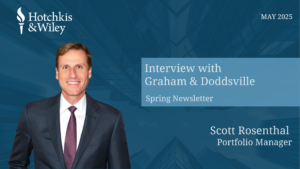
Global Value Portfolio Manager Scott Rosenthal was featured in Graham & Doddsville, an investment newsletter from students of Columbia Business School.

Download complete Spring issue here.


________________________________________

All investments contain risk and may lose value. This material is for general information purposes and should not be used as the sole basis to make any investment decision. Views expressed are not intended to be relied upon as research regarding a particular industry,investment or the markets in general, nor is it intended to predict performance of any investment or serve as a recommendation to buy or sell securities. Hotchkis & Wiley (“H&W”)is not responsible for any damages or losses arising from any use of this information.

The portfolio manager’s views and opinions expressed are as of May 12, 2025. Such views are subject to change without notice and may differ from others in the firm, or the firm as a whole. The portfolio manager’s comments may include estimated and/or forecasted views, which are believed to be based on reasonable assumptions within the bounds of current and historical information. However, there is no guarantee that any estimates, forecasts or views will be realized. In the event of new information or changed circumstances, H&W reserves the right to change its investment perspective and outlook and has no obligation to provide revised assessments and/or opinions.

Data sources: Graham and Doddsville. Information obtained from independent sources is considered reliable, but H&W cannot guarantee its accuracy or completeness. Certain information contained in this material represents or is based upon forward-looking statements. Due to various risks and uncertainties, actual events/results or performance may differ materially from those reflected or contemplated in such forward-looking statements. Nothing contained herein may be relied upon as a guarantee, promise, assurance or a representation as to the future. H&W is not responsible for any damages or losses arising from any use of this information.

This is a moderated discussion with personnel from H&W and external parties. The views expressed by each party are their own and H&W does not endorse any of the opinions, products or services offered by external parties. 

Past performance is not indicative of future performance.

©2026 Hotchkis & Wiley. All rights reserved. No portion of this article may be published, reproduced or transmitted in any form without the express written permission of H&W.


________________________________________

Investors should consider the investment objectives, risks, charges and expenses carefully before investing. For a prospectus or summary prospectus with this and other information about the SMID Cap Diversified Value ETF please visit www.hwcm.com OR call 1-800-796-5606. Read the prospectus or summary prospectus carefully before investing.

Investing in smaller, medium-sized and/or newer companies involves greater risks than those associated with investing in larger companies. Please read the prospectus for a full list of fund risks. Diversification does not assure a profit nor protect against loss in a declining market.

ETFs are subject to additional risks that do not apply to conventional mutual funds, including the risks that the market price of an ETF’s shares may trade at a premium or discount to its net asset value (NAV), an active secondary trading market may not develop or be maintained, or trading may be halted by the exchange in which they trade, which may impact an ETF’s ability to sell its shares. Unlike mutual funds, ETF shares are bought and sold at market price, which may be higher or lower than their NAV, and are not individually redeemed from the fund. Brokerage commissions will reduce returns.

New funds have limited operating histories for investors to evaluate and new and smaller funds may not attract sufficient assets to achieve investment and trading efficiencies.

Investing involves risk. Principal loss is possible.
The SMID Cap Diversified Value ETF is distributed by Quasar Distributors, LLC

©2026 Hotchkis & Wiley. All rights reserved. No portion may be published, reproduced or transmitted in any form without the express written permission of H&W.

Portfolio Manager Mark Hudoff reviews:

  • Performance drivers in Q1 2025
  • Credit spread widening
  • Tariff impact on the portfolio
  • Market volatility
  • Portfolio positioning and our current assessment of high yield fundamentals, technicals, and valuation


________________________________________

The performance data quoted represents past performance and does not guarantee future results. Current performance may be lower or higher. Investment return and principal value of the fund will fluctuate, and shares may be worth more or less than their original cost when redeemed. To obtain performance data current to the most recent month-end, access our website at www.hwcm.com.

Hotchkis & Wiley High Yield Fund standardized performance - from the dropdown menu, select month-end or quarter-end standardized fund performance.  Click here for the standard yield.

You should consider the Hotchkis & Wiley High Yield Fund’s investment objectives, risks, and charges and expenses carefully before you invest. This and other important information is contained in the Fund's summary prospectus and prospectuswhich can be obtained by calling 800-796-5606. Read carefully before you invest.

Investments in debt securities involve credit risk and typically decrease in value when interest rates rise. Investments in lower rated and non rated securities involve greater risk. The fund may invest in derivatives, asset backed and mortgage backed securities, and foreign securities. Please read the fund prospectus for a full list of fund risks.  

This material is for general information purposes and should not be used as the sole basis to make any investment decision. Views expressed are not intended to be relied upon as research regarding a particular industry, investment or the markets in general, nor is it intended to predict performance of any investment or serve as a recommendation to buy or sell securities. Hotchkis & Wiley (“H&W”) is not responsible for any damages or losses arising from any use of this information.

The portfolio manager’s views and opinions expressed are as of April 24, 2025. Such views are subject to change without notice and may differ from others in the firm, or the firm as a whole. The portfolio manager’s comments may include estimated and/or forecasted views, which are believed to be based on reasonable assumptions within the bounds of current and historical information. However, there is no guarantee that any estimates, forecasts or views will be realized. In the event of new information or changed circumstances, H&W reserves the right to change its investment perspective and outlook and has no obligation to provide revised assessments and/or opinions.

Information obtained from independent sources is considered reliable, but H&W cannot guarantee its accuracy or completeness. Certain information contained in this material represents or is based upon forward-looking statements. Due to various risks and uncertainties, actual events/results or performance may differ materially from those reflected or contemplated in such forward-looking statements. Nothing contained herein may be relied upon as a guarantee, promise, assurance or a representation as to the future.

Small to Mid-Caps (SMIDS) bonds; Spread usually refers to the difference between two prices (the bid and the ask) of a security or asset, or between two similar assets; Duration measures the price sensitivity of a bond to interest rate movements; Basis Points is a unit equal to 1/100th of 1% and is used to denote the change in a financial instrument; Tariffs are taxes imposed by one country on goods imported from another country; Gross Domestic Product (GDP) is the standard measure of the value added created through the production of goods and services in a country during a certain period; Collateralized Loan Obligation (CLO) is a securitization product created to acquire and manage a pool of leveraged loans; GFC - global financial crisis; ETF - Exchange Traded Fund; M&A - Mergers and Acquisitions; LTM - last twelve months; Top ten holdings as of 12/31/25 as a % of the Fund’s net assets: CCO Holdings LLC 1.6%, Carnival Corp. 1.3%, Boardriders Inc. 1.2%, Lloyds Banking Grp PLC 1.0%, W.R. Grace Hldgs LLC 1.0%, SCIL USA  Hldgs LLC  0.9%, Central Parent LLC 0.9%, Fortis Term Loan Senior Secured 0.9%, TransDigm Inc. 0.8%, and ING Groep N.V. 0.8%. Fund holdings and/or sector allocations are subject to change and are not recommendations to buy or sell any security. Diversification does not assure a profit nor protect against loss in a declining market.

The ICE BofA BB-B US High Yield Constrained Index contains all securities in the ICE BofA US High Yield Index rated BB+ through B- by S&P (or equivalent as rated by Moody’s or Fitch), but caps issuer exposure at 2%. Index constituents are capitalization weighted, based on their current amount outstanding, provided the total allocation to an individual issuer does not exceed 2%. Unless otherwise noted, “high yield” market refers to the ICE BofA US High Yield Index. The ICE BofA US High Yield Index tracks the performance of below investment grade, but not in default, US dollar-denominated corporate bonds publicly issued in the US domestic market, and includes issues with a credit rating of BBB or below, as rated by Moody’s, Fitch and S&P. The indices do not reflect the payment of transaction costs, fees and expenses associated with an investment in the Fund. It is not possible to invest directly in an index.

Bond ratings are grades given to bonds that indicate their credit quality as determined by private independent rating services such as Standard & Poor's, Moody's and Fitch. These firms evaluate a bond issuer's financial strength, or its ability to pay a bond's principal and interest in a timely fashion. Ratings are expressed as letters ranging from 'AAA', which is the highest grade, to 'D', which is the lowest grade. Investment Grade includes credits that are BBB- or above.

Past performance is not indicative of future performance.

Mutual fund investing involves risk. Principal loss is possible.
The Hotchkis & Wiley Funds are distributed by Quasar Distributors, LLC

©2026 Hotchkis & Wiley. All rights reserved. No portion of this podcast may be published, reproduced or transmitted in any form without the express written permission of H&W.


________________________________________

Investors should consider the investment objectives, risks, charges and expenses carefully before investing. For a prospectus or summary prospectus with this and other information about the SMID Cap Diversified Value ETF please visit www.hwcm.com OR call 1-800-796-5606. Read the prospectus or summary prospectus carefully before investing.

Investing in smaller, medium-sized and/or newer companies involves greater risks than those associated with investing in larger companies. Please read the prospectus for a full list of fund risks. Diversification does not assure a profit nor protect against loss in a declining market.

ETFs are subject to additional risks that do not apply to conventional mutual funds, including the risks that the market price of an ETF’s shares may trade at a premium or discount to its net asset value (NAV), an active secondary trading market may not develop or be maintained, or trading may be halted by the exchange in which they trade, which may impact an ETF’s ability to sell its shares. Unlike mutual funds, ETF shares are bought and sold at market price, which may be higher or lower than their NAV, and are not individually redeemed from the fund. Brokerage commissions will reduce returns.

New funds have limited operating histories for investors to evaluate and new and smaller funds may not attract sufficient assets to achieve investment and trading efficiencies.

Investing involves risk. Principal loss is possible.
The SMID Cap Diversified Value ETF is distributed by Quasar Distributors, LLC

©2026 Hotchkis & Wiley. All rights reserved. No portion may be published, reproduced or transmitted in any form without the express written permission of H&W.

HOTCHKIS & WILEY
Privacy Overview

This website uses cookies so that we can provide you with the best user experience possible. Cookie information is stored in your browser and performs functions such as recognising you when you return to our website and helping our team to understand which sections of the website you find most interesting and useful.